New paper: Measuring pedestrian well-being in the wild
Yasaman Hakiminejad’s new article, “A multimodal human-centered framework for assessing pedestrian well-being in the wild,” has been published in the Journal of Urban Mobility. The work brings us closer to measuring cities through the people who experience them.
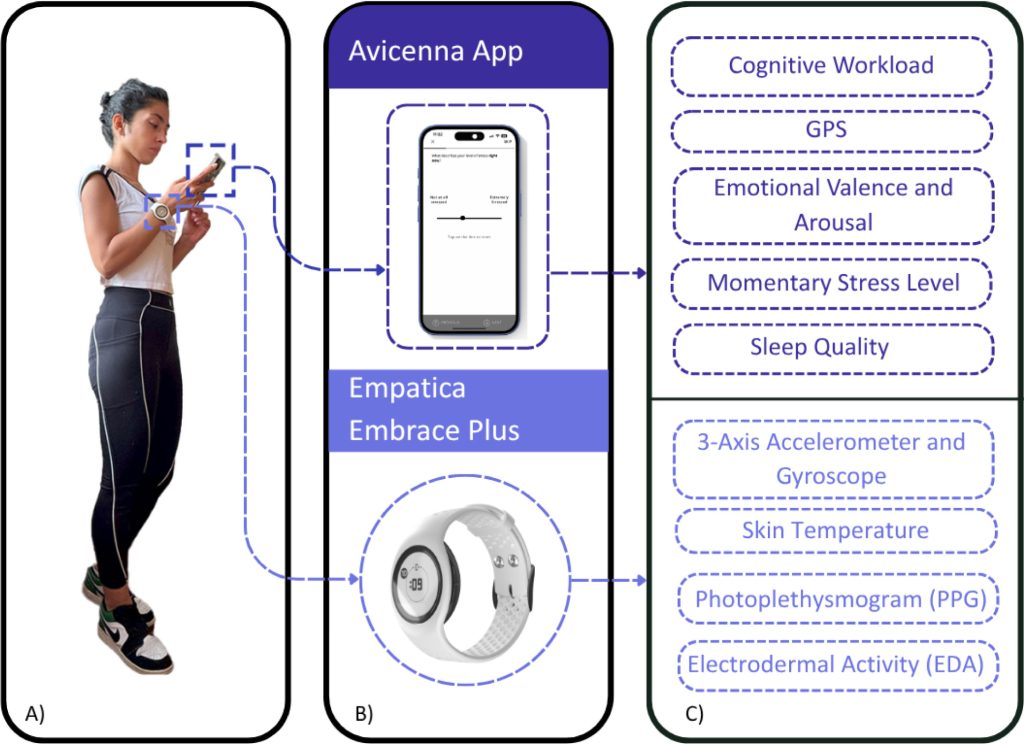
The paper introduces a framework that combines wearable physiological sensing, GPS trajectories, and experience sampling to understand pedestrian well-being during everyday walking, bringing together environmental context, physiological responses, and people’s own perceptions. Yasaman single-handedly carried out a fully naturalistic, two-week field study to demonstrate that the framework works in real-world settings.
The observations showed variability both between participants and within the same participant over time, along with context-dependent patterns that may be related to traffic exposure, pedestrian infrastructure, and environmental enclosure. The study lays a foundation for more detailed analyses and future work with larger and more diverse populations.
This work was supported by the U.S. National Science Foundation. The article is open access.